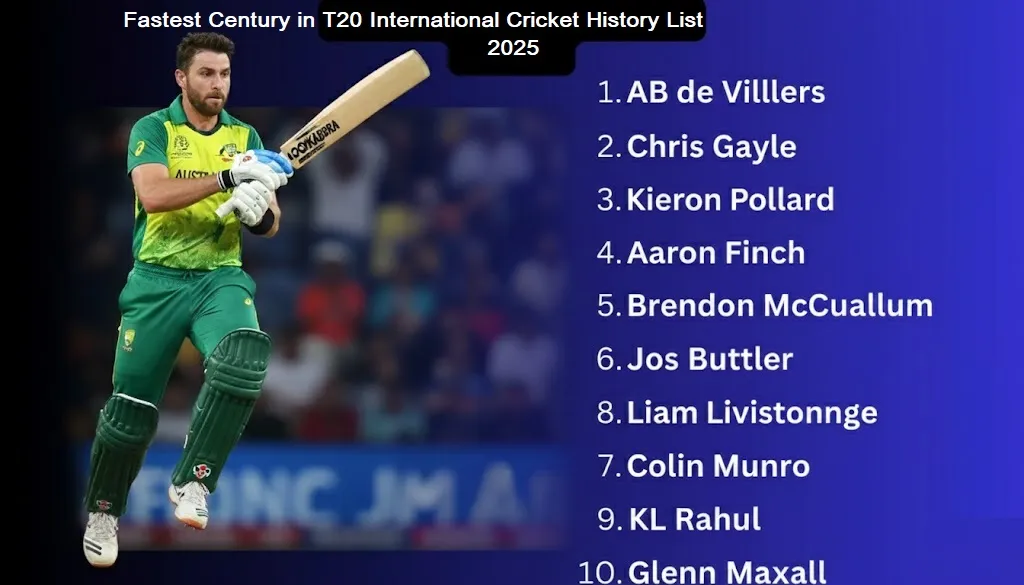

The race for the Fastest Century in T20 International Cricket History List has seen numerous file-breaking knocks over the years. From the earliest explosive centuries through established stars to explosive blitzes with the aid of emerging players from associate countries the file books preserve evolving. This article offers the definitive, up to date listing of quickest T20I centuries, contextualises their significance, and analyses the elements behind such blazing innings.
Table of Contents
Why Fast Centuries Matter in T20Is
T20 cricket, via design, is lightning-speedy. A century in a T20 global is rare; a Fastest Century (low balls taken) is brilliant. Such innings now not best shift matches dramatically however also redefine strike-fee benchmarks. For lovers and analysts, the Fastest Century in T20 International Cricket History List serves as a barometer of batting dominance, changing dynamics of cricket grounds, bowling nicely, and batting aggression in contemporary cricket.
Top Fastest T20I Centuries Complete List
Here’s a curated listing of the quickest centuries in T20 International (T20I) cricket ranked by means of balls faced. This desk displays achievements as far as 2025.
| Rank | Player | Country / Team | Balls Faced | Opponent | Venue / Match | Date / Year |
|---|---|---|---|---|---|---|
| 1 | Sahil Chauhan | Estonia | 27 | Cyprus | Episkopi | 17 Jun 2024 |
| 2 | Jan Nicol Loftie-Eaton | Namibia | 33 | Nepal | Kirtipur | 27 Feb 2024 |
| 3 | Sikandar Raza | Zimbabwe | 33 | Gambia | Nairobi (Ruaraka) | 23 Oct 2024 |
| 4 | Kushal Malla | Nepal | 34 | Mongolia | Hangzhou | 27 Sept 2023 |
| 5 | David Miller | South Africa | 35 | Bangladesh | Potchefstroom | 29 Oct 2017 |
| 5 (tie) | Rohit Sharma | India | 35 | Sri Lanka | Indore | 22 Dec 2017 |
| 5 (tie) | Sudesh Wickramasekara | Czech Republic | 35 | Turkey | Ilfov County | 30 Aug 2019 |
| 8 | Abhishek Sharma | India | 37 | England | Mumbai (Wankhede) | 02 Feb 2025 |
| 9 | Sheikh Rasik | Hungary | 37 | Malta | Marsa | 04 Feb 2025 |
Note: Some lesser-acknowledged or associate-kingdom matches dominate top spots, a sign that weaker bowling gadgets and smaller grounds frequently cause fast centuries.
Records & Notable Highlights from the Fastest Century List
Fastest ever — Sahil Chauhan (27 balls)
- Sahil Chauhan’s 27-ball century remains the quickest in T20I history. That blazing knock got here for Estonia against Cyprus in June 2024 at Episkopi.
- His feat underscores how rising cricket countries and favourable conditions can produce file-shattering innings.
Rarity of Century in T20Is
Given each innings lasts most effectively a hundred and twenty deliveries (20 overs × 6 balls), reaching 100 runs in ~30–35 balls — 1 / 4 or less demands non-forestall competitive batting, brilliant timing, and favourable pitch/bowling situations.
Diverse Backgrounds of Record-Holders
- From complete member nations (like South Africa, India) to accomplice or lesser regarded groups (like Estonia, Namibia, Nepal, Hungary, Czech Republic), the listing spans an extensive geographic spectrum.
- This range suggests T20I’s democratizing effect information isn’t constrained to conventional powerhouses.
Trend of Increasing Strike and Aggression
Earlier T20I centuries (pre-2020) regularly took 35+ balls. Recent years with better bats, cutting-edge hitting techniques, and more attacking mindsets have trimmed that number sharply (to 27–33 balls). The quickest century in T20 international cricket history list displays this shift.
Why Some Centuries Are Faster Than Others — Key Factors
1. Bowling Quality & Opposition Strength
Matches among lesser recognised cricket countries regularly feature weaker bowling attacks. This tends to allow competitive batting, mainly for quicker loads. Many file speedy loads have such suits available.
2. Ground Dimensions & Pitch Conditions
Smaller grounds or flatter pitches assist boundaries come without difficulty. Batsmen like Sahil Chauhan or Jan Nicol Loftie Eaton exploited such conditions.
3. Batting Approach & Strike Rate
Modern T20 batters intention for excessive strike prices from ball one. Aggressive motive, quick footwork, and strength-hitting maximize boundary count number and decrease dot balls critical for a fast century.
4. Match Situation & Strategy
Sometimes a crew needs quick runs (chasing a massive total or accelerating after a crumble). That urgency can push batters into high-risk, high-praise hitting best conditions for a file-rapid ton.
Comparison: Fastest T20I Centuries vs Traditional Classics
Traditionally, century making batsmen paced their innings building progressively, rotating strike, saving strength hitting for later overs. But the fastest century in T20 international cricket history list reflects a one of a kind mind-set:
- Aggression from the primary ball
- High-threat, excessive praise batting
- Minimal subject for sturdiness just maximum scoring
- Often at the cost of wickets, however that’s proper in T20 context
This shift highlights how the T20 layout has converted batting paradigms.
Controversies & Considerations with “Fastest Century” Records
- Quality of opposition: Critics argue centuries towards weaker bowling devices ought to be regarded in a different way than those in opposition to pinnacle tier worldwide teams.
- Ground and pitch fairness: Smaller grounds or batting-friendly pitches provide massive benefit — skewing comparison across information.
- Match context: A century in an excessive pressure chase or in opposition to a pinnacle bowl assault carries greater weight than one in a one sided suit.
- Statistical inflation: As greater associate international locations get T20I reputation, report-breaking turns into extra frequent, truly diluting the rarity of “quickest centuries.”
Hence, at the same time as the fastest century in T20 international cricket history list is a useful benchmark, it must be interpreted in context.
Evolution of Fastest Centuries Timeline Trends
| Period / Era | Typical Fastest T20I Centuries (Balls) | Observations |
|---|---|---|
| Early to mid-2010s | 35–40 balls | Traditional batting approach; fewer aggressive innings |
| Late 2010s (2016–2019) | 35 balls (e.g., David Miller, Rohit Sharma) | Rise of aggressive T20 batting among top-tier nations |
| 2020–2022 | Few sub-35 ball centuries | Increasing influence of associate nations, more T20Is globally |
| 2023 onwards | 27–34 balls | Record-breaking centuries more frequent — surge from emerging nations and aggressive modern style |
This trend suggests that as T20I will become more worldwide and aggressive batting more not unusual, the fastest century in T20 international cricket history list will retain to evolve.
Implications for Fans, Players & Cricket Analysts
- Fans: More thrilling suits, interesting chases, and surprising heroes from both mounted and rising nations.
- Players: Rise of all-round rapid-hitters who can change video games in quick spans. Even lesser-known gamers now intend for instant centuries.
- Analysts & Selectors: Greater recognition on strike charge, power hitting, and adaptableness not just steadiness. Scouting widened to associate country stars.
- T20 Format Evolution: As boundaries decrease mentally and gamers bat extra freely, T20I keeps pushing the limits of batting information and redefines what’s “everyday.”
Conclusion
The fastest century in T20 international cricket history list tells a compelling tale of ways T20 cricket has evolved. From traditional pacing to relentless aggression from ball one batting in T20Is has converted. While information like Sahil Chauhan’s 27-ball ton already stand out, upcoming suits amongst each full-member and accomplice international locations may want to carry even faster centuries.
Summary
The fastest century in T20 international cricket history list highlights blazing knocks with the aid of players like Sahil Chauhan (27 balls), Jan Nicol Loftie-Eaton (33 balls), Sikandar Raza (33 balls), Kushal Malla (34 balls), David Miller and Rohit Sharma (35 balls). These explosive innings reflect changing batting techniques, floor situations, and the global boom of T20I cricket.
Main questions to ask on this — Everything You Need to Know
Are all entries inside the quickest century listing from complete member nations?
No. Many come from associate or smaller cricket countries (e.G., Estonia, Nepal, Namibia, Hungary, and many others.), displaying that file breaking T20I innings aren’t restricted to fundamental cricketing nations.
What elements make a contribution most to a fast T20I century?
Key elements: weaker bowling attacks or inexperienced bowlers, batting-pleasant pitch & small ground length, competitive batting method with high strike charge, and suit state of affairs requiring rapid runs.
Does scoring a quick century constantly imply the innings become excessive first-class?
Not necessarily. A speedy ton may be much less surprising if scored towards vulnerable opposition or on a small batting pleasant pitch. Context opponent satisfactory, in shape significance, pitch, and stress — matters in evaluating first-class.
Is the trend of quicker centuries in all likelihood to retain?
Yes. With growing global T20I participation, modern-day aggressive batting strategies, improved bats, and favorable conditions the quickest century in T20 worldwide cricket records listing can also shrink similarly in balls confronted, and facts will probably preserve evolving.